
- |
- 中文|
Institute of Cognitive Computing and Intelligent Information Processing
Directions and Faculties
Topics: 3D computer graphics and physical modeling technology, multi-mode human- computer interaction and augmented reality technology, data mining and computer vision based material domain knowledge discovery, digital twin-driven research on Intelligent control and visualization technology for industrial processes.
Faculties: Professor Ban Xiaojuan, Associate Professor Zhou Peng, Lecturers include Guo Yu Wang Xiaokun, Yao Chao, Post-doc Fellow Dr. Zhang Yalan.
Leading Proferssor: Ban Xiaojuan
Prof.Ban has long been engaged in the research of artificial intelligence, human-computer interaction and 3D visualization. She has led a number of national and provincial scientific research projects during the 13th Five-Year Plan period, including the National Key R&D Program, the National Natural Science Foundation, 863 Program, and exploration projects of the General Armament Department. Prof. Ban serves as the executive Director of the Chinese Society of Artificial Intelligence, and director of the Chinese Intelligent Medical Professional Committee. She is a member of the Human-Computer Interaction Professional Committee
of China Computer Federation.
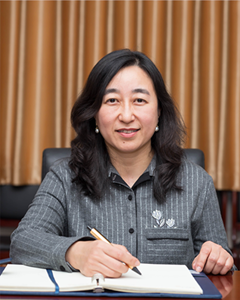
Prof. Ban Xiaojuan
Research
3D Computer Graphics and physical modeling technology
3D Computer Graphics majors at the process of discretizing physical constraint equation and dynamic process, designing computer solver algorithm, producing simulation sampling data, and generating visual animation. With both highly economic and applicational value, the research serves a variety of fields like animation industry, industrial production and military exercises, etc. The development of virtual reality and augmented reality technology along with the animation industry requires a pursuit of real-time and accurate performance of the computer visualization, making the field carry out the research of physical simulation model based on neural network for data-driven and deep learning algorithm.
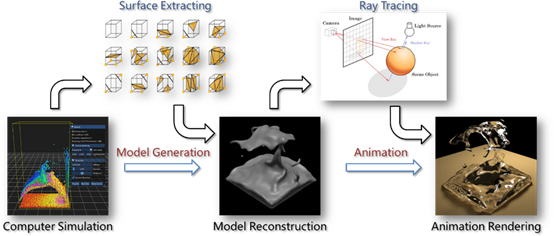
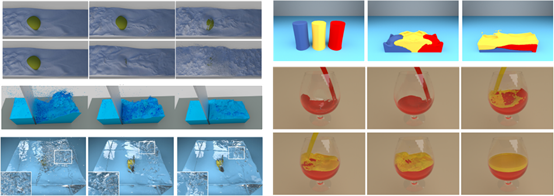
Left: turbulence detail recovery Right: surface reconstruction for multiphase fluid
Publications and Projects
In this direction, our team has conducted a thorough research in graphics and physical modeling, including turbulence recovery, surface reconstruction, self-adaptive time step, non Newtonian fluid simulation and deep learning fluid simulation. More than 10 SCI journal papers and 10 international conference papers has been published, among which several articles have been published in Siggraph Asia and IEEE Virtual Reality, as well as in Computer Graphics Forum and The Visual Computer of CCF B/C journals. In terms of the foundation, The lab has been granted by two general programs of the National Natural Science Foundation of China ("Non-homogeneous Fluid Oriented Interactive Animation", "Efficient Data Driven Fluid Simulation for Multi-element Scenarios") .
Multi-modal Human-computer Interaction and Augmented Reality Technology
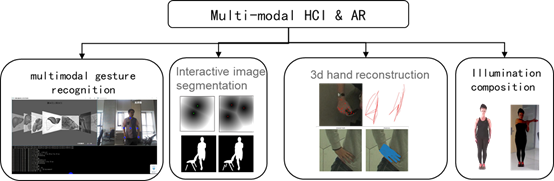
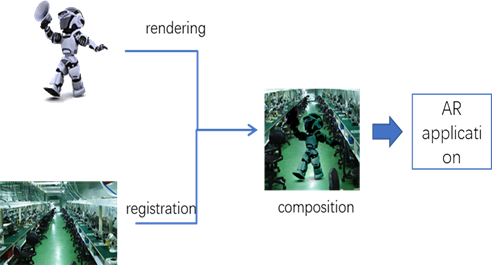
Multi-modal human-computer interaction enables humans to combine different modalities for the interaction with the high performance in the naturality and accuracy, through acquiring multi-mode data and processing them cooperatively. Our main research interests include human posture recognition, gesture recognition, eye tracking, interactive instance-aware segmentation, robotics and visual simultaneous localization and mapping (SLAM), 3D reconstruction, augmented reality, and other human-computer interaction related technologies, which can be widely used in the fields of intelligent medical treatment, wearable devices, service robots, industry and manufacture, and so forth.
Publications and Projects
In this direction, our team has participated in a number of interactive platform development projects, including National Key Research Program and the National Natural Science Foundation of China. We have published over 10 papers, journals papers include IEEE Trans. Multimedia, IEEE Trans. CSVT, IEEE Systems Journal, Ad Hoc Networks, and IEEE Sensors Journal, conferences papers include ECCV, ICC, CHI, and CyberDI. In addition, we have applied for 5 patents.
Data Mining and Computer Vision based Material Domain Knowledge Discovery
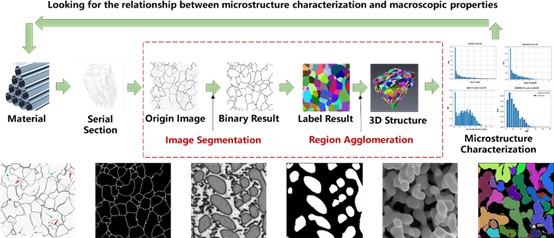
As an interdisciplinary research direction, we try to apply data mining and computer vision technology to materials science, analyze the structural information in microstructure images by computer vision technology, and extract the association relationship in the whole chain of material composition, technology, organization and performance by using data mining technology, and finally accelerate the research and development of new materials. At the same time, our team also interested in the research of applying online computervision based monitoring technology on steel manufacturing. The applications covers the whole process of metal manufacturing industry, including billet casting, plate/strip/type/rod and wire rough rolling, finishing rolling, straightening, cutting and other processing sections; and horizontally covers product surface quality inspection, intelligent logistics tracking, product size/profile measurement, visual guidance control and other products.
Publications, Projects, and Awards
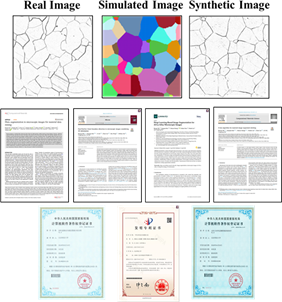
We have conducted a thorough research in material microscopic image analysis, including image stitch, image fusion, image segmentation, target detection, image generation, target tracking and 3D reconstruction and characterization. We have participated in one National Key Research and Development Program of China, published more than 10 SCI/EI papers, applied/granted 10 patents, 5 computer software copyrights, and published 2 open source code projects. Particularly, our team developed an online computer vision and AI based surface defect detection system for industrial steel manufacturing, with independent intellectual property rights. The system realizes online detection of steel surface defects in high temperature casting billets at 1000℃ for the first time in the world. Our technology has won several provincial awards, including
The first prize of 2008 Metallurgical Science and Technology Award
2012 Metallurgical Science and Technology Progress Award
2013 Scientific Progress Award of Ministry of Education
2019 the first prize of Beijing Scientific and Technological Progress Award
2019 Jiangsu Scientific and Technological Progress Award
The first prize of 2020 Metallurgical Science and Technology Award
2020 Fujian Scientific and Technological Progress Award
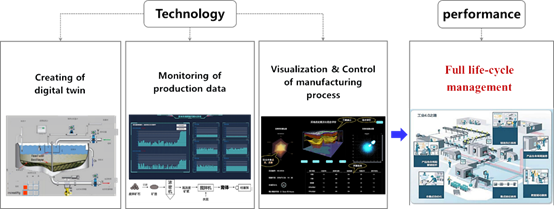
Digital Twin-driven Research on Intelligent Control and Visualization Technology for Industrial Processes
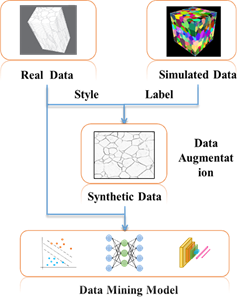
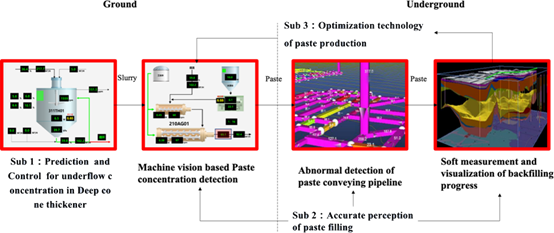
To address the problems of complex production processes and noise interference in industrial processes, this research is devoted to develop a digital twin model for typical processes and operation scenarios and build an Industry 4.0 intelligent manufacturing system to achieve real-time monitoring of production data and state estimation by jointly using system identification, representation learning, 3D visualization and integration, fusion and state estimation methods of massive heterogeneous sensor data. The research aims at achieving intelligent control, failure timely warning, closed-loop iteration for industrial manufacturing process, and ultimately realizing model-driven manufacturing process life-cycle collaboration. We plan to conduct practical verification in the field of mine filling, design visualization & analysis system, and form a typical solution to optimize paste quality, reduce filling costs, improve operational stability and reduce labor intensity.
Publications and Projects
In the direction of intelligent paste backfilling, we have conducted a thorough research on the predictive and adaptive control of underflow concentration, computer vision based concentration detection, soft measurement and 3d visualization of backfilling progress and abnormal detection of paste conveying pipeline. We have participated in 1 National Key Research and Development Program of China and 2 cooperated projects with enterprises. We have published more than 5 SCI/EI journal papers, applied/granted 5 patents, and 1 computer software copyright.
